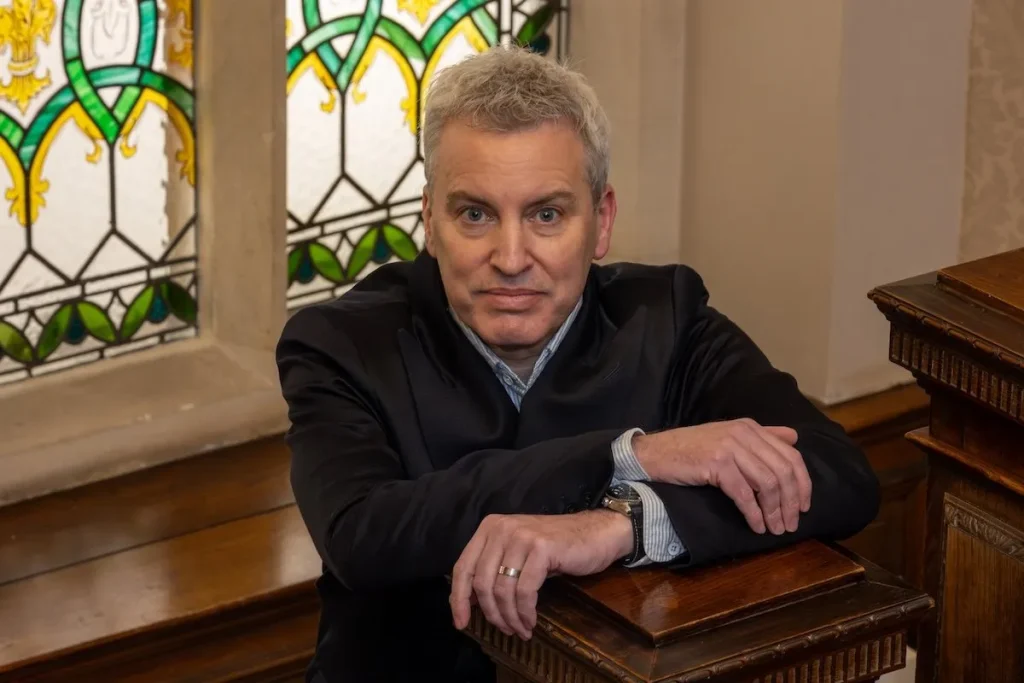

I know what you’re probably thinking, why in the world do we need another streaming service
The market already has Spotify, Deezer, Pandora, Rdio and Google Play Music, while Apple entered the foray with Apple Music in the summer.
Well, according to Electric Jukebox Company founder Rob Lewis, they’re all far too complicated and the average consumer quite simply wants to buy a product that works without lengthy installation processes.
So that’s exactly what Lewis set out to create.
As a serial entrepreneur, he’s spent time in publishing and politics, with a particular appetite for Business & Technology the name of the magazine he created and sold to Dennis Publishing.
As such, he followed up with a move into internet enterprises, most notably software firm Cromwell Media and then tech news site Silicon.com. The former was sold for a reported 850min 2000 and the Silicon Media Group was bought by CNET in 2002.
But it was the next venture that set Lewis on the path to create Electric Jukebox, when he launched Omnifone in 2003. The provider of music streaming services partnered with firms including Sony and BlackBerry and powered the music platforms that the manufacturers offered to consumers.
The success prompted a spin-off to arrive in 2011, coming in the form of consumer-facing service Rara.com, which has now been closed. In the words of Lewis, the aim was to produce a digital music service that’s designed for the mass market of people who are either not technically literate, or like music but don’t know a huge amount about it.”

It wasn’t meant to be though and the business is no longer operational, following a CEO exit. Undeterred, however, Lewis now returns with Electric Jukebox, which was formally revealed during a celebrity-tinged, government-approved event held at BAFTA headquarters on 14 October.
Seemingly, having combined his lessons from over the years, Lewis has this time created a tangible product that fuses hardware with accessibility to stream millions of songs, using the simple Rara.com ideal.
The caveat is that the device must be plugged into a TV and connected to WiFi to work, which means that portability isn’t on the menu but Lewis is comfortable with that.
When speaking to him, I highlighted that I already have Spotify, which works perfectly because of usability on the move during exercise and commutes.
It’s probably not for you. That’s the reality. There is a consumer base who are already using streaming, they’re very dedicated, they’ve got very good choice and lots of people offering them a 10 subscription, so you’re very well looked after,” he said.
But there’s a lot of consumers who don’t go jogging in the morning, who don’t like technology, and who just want to buy something that they plug in and it works.
Read more on the music streaming industry:
- Taylor Swift blasted shocking Apple Music demand that artists work for free and won
- British labels say Apple Music terms would “put people out of business”
- Apple Music out to rot core of Spotify and Tidal with former Radio 1 DJ Zane Lowe
The firm provided research to say that 200m people worldwide bought CDs each month back in 2005 a number that has plummeted to 40m in 2015.
So how will another streaming service revive CDs It won’t. But Lewis is betting on Electric Jukebox taking streaming to the masses to benefit the music industry as a whole.
“Would you buy a CD or individual track anymore Of course not, it’s madness,” Lewis continued. One of the great things about streaming is that if you hear something, you can add it to the collection without wondering whether to pay for individual tracks.
That experience is clearly wonderful but, despite the fact it’s been around for ten years, the bottom line is that most people are listening to music at home on their radio or CD and they’d love to do streaming but they don’t. That’s because they say it’s too complicated, too expensive and they hate monthly subscriptions.

The Electric Jukebox product is billed as being a part of the Internet of Things (IoT), owing to its tangible design revolving around the web. The governments John Whittingdale, secretary of state for culture, media and sport, was on hand on the day to offer his approval of the venture.
“We are in the middle of a digital revolution. The first stage of the internet changed lives and opened up a world of knowledge never available to most people and it removed geographical boundaries,” he said.
“We’re now moving into the second stage, the so-called Internet of Things. It’s estimated by 2020, 26bn devices will be connected. It provides great opportunities, particularly for us in this country.
Whittingdale referenced the remarkable wealth of creativity found in British music, film, TV and games industries, which he said puts us among the most successful in the world .
Looping back around to Electric Jukebox, he added: We’re also very strong in IT and we’re an entrepreneurial nation. I think this [Electric Jukebox] is a very exciting idea, but particularly exciting for consumers. This change that is taking place is creating great challenges for business models and some of the old models are breaking down, but it’s the opportunities for new industries to spring up and that is what we’re here for.
Electric Jukebox: The celeb-backed Spotify alternative out to invade your home
He joked that users won’t need an electrical engineering degree to get around the device, unlike the software offered by Spotify et al and hardware such as Sonos both of which were called out by Lewis on the day for being too arduous for the casual user to operate.
Hardware, software and service in one Spotify/Sonos challenger @ElectricJukebox has embraced #IoT for music pic.twitter.com/4OTmXc0LbU
” Real Business (@Real_Business) October 14, 2015
In order to differentiate itself, users will pay 179 for an Electric Jukebox to secure full ownership of the product. It comes with a 12-month premium streaming package included, so theres no need to pay anything to listen until that runs out at which point customers will need to pay 60 for another 12-month package if they want the full catalogue, or use the free, limited version that comes with ads.
“We all subscribe to some kind of service whether it’s a magazine subscription or gym membership and then forget to unsubscribe. Any recurring subscription is something people will only do if they really want the end product and there’s a lot of consumers who won’t do it full stop,” said Lewis, explaining the reason for the payment process.
The concept here is, give them something that works out of the box and, even at the end of the first year, let it carry on working. If they want to continue with a premium product they pay 60 for a 12-month pass. We’ll never do that recurring thing and that brings it to another level.
He argued that 60 is an affordable price when you spread that over a year, compared to Spotify or the like, which will cost users 120 over 12 months.
Given the firm is out to target people that want a simple musical life, the topic of target audience arose. According to Lewis, Electric Jukebox can expect young families to embrace the product as parents in their thirties with young children polled the best.
“We did a huge amount of research and looking at the consumer types, they’ve got a fridge, washing machine, drier and TV, probably Sky or cable have they got music streaming No. We’re trying to make the streaming as commonplace as these old things. The only way to do that is to make it as simple as those things, and make it an appliance,” he said.
Continue reading on the next page as Lewis explains how he plans to keep streaming adversaries like Taylor Swift on side, and why it was so important to have a corporate cocktail including execs from Super Group and Visa on the board.

Of course, the streaming industry has had its share of bad press. Taylor Swift has been quick to speak out on the practices of the companies and has attacked Spotify and Apple Music for making money while artists lose out.
Talking on how the company will avoid attacks from the American superstar, Lewis said: In terms of the business, we’re trying to make sure that consumers can enjoy music at home again. That’s good for us because we’re a consumer electronics business and the first to do an IoT for music.
It’s also good for consumers because it gets rid of hassle and brings music back, and that is good for rights owners because consumers are not participating any longer they’re consumers of radio and old CDs.
The music industry can have a massive reemergence if it can start growing again. The key isn’t going from 40m-50m paid subscribers, but from 40m to 400m, and that’s the only way it’s going to grow.
Referring to himself as a very successful entrepreneur , Lewis admitted that he funded the project himself in the beginning, though a number of investors from the Far East are now on board. They sit alongside an unnamed very large investment company that’s putting substantial amounts of marketing funds into the business so we can do a big splash marketing campaign .
He added the brand will be seen everywhere, hence the support of celebrities like Sheryl Crow and Robbie Williams.
A look beyond the red carpet elite and around the BAFTA venue and it was clear that Electric Jukebox already has a substantial amount of staff members for a startup at 40 full-timers, though that number creeps to 100 with outsourcing considerations.
It’s much more complex than a music streaming service because you’re doing the licensing, reporting, user experience, hardware, logistics, marketing and retail support,” detailed Lewis.
Elsewhere, the board is made up of a powerhouse variety of business executives, with some of the names including: former Visa International president, Malcolm Williamson; U2’s ex-manager; founder of The Brits, Rob Dickins; EMI’s former global CEO; the ex-FD from Island Records; the founder of TomTom; a former partner of Deloitte, and Susan Given, the former COO of Super Group and MD of TK Maxx.

According to Lewis, that mixture of corporate players was paramount because the company is going into the unknown.
“We’re doing something that’s never been done before and we need to treat the music in the way it should be treated,” he said.
“We need to be sure we work with retailers correctly with people from Superdry, we’ll need corporate governance on the basis we’ll be a big business very quickly, so Malcolm Williamson [ex-Visa] and some tax people. And we need to be very aware of competition, so we have Stephen Hornsby [Goodman Derrick partner], who wrote the textbook on competition law, on-board.
“We need a great team. We’re trying to change the way everyone in the world listens to music and that’s quite a lofty goal.
From the time Lewis embarked on said lofty goal by beginning Electric Jukebox, until now, it’s been two years. But without his decade of experience, the venture would have been a flop, he said.
I’ve been in music industry for ten years and if I hadn’t done that, we’d have had absolutely no hope. I mean really no hope,” he said frankly, explaining the complexities of streaming requiring licensing, reporting structures and various tax regimes. There’s also trust as an issue.
You have to know the people because it’s an industry that’s quite suspicious of tech companies. Some think tech has come and done bad things or not really helped out.
The key was to have industrial design expertise, UX, licensing, marketing, talent, and some of those areas, particularly industrial design and manufacturing, I was new to. I worked very closely with Sony Ericsson and BlackBerry, but I’d never done manufacturing myself before.
Now it’s relatively easy, with production line technology and capabilities have enabled a raft of new companies in the IoT to emerge. We believe it’s about as big as it can be in IoT it’s music for everyone.