
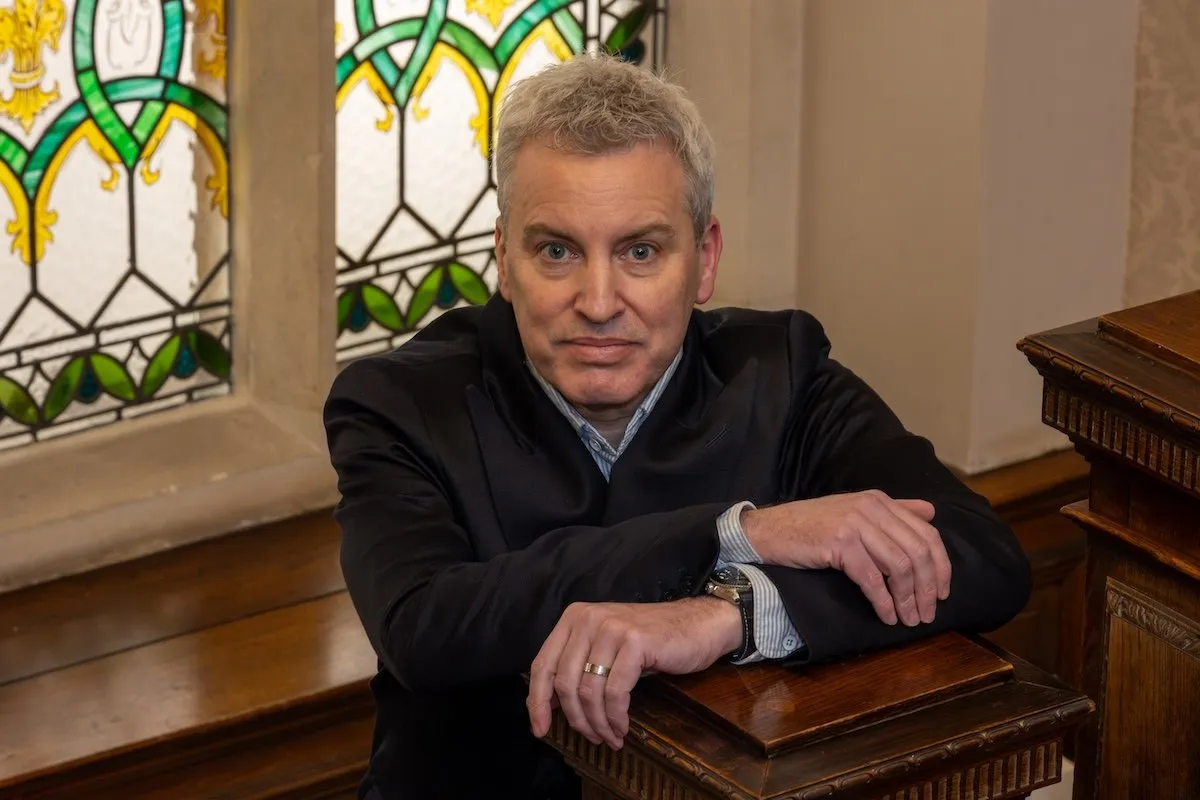
You know the term, digital transformation? Well, Mark Sweeny is something of an expert in it. He’s the founder de Novo Solutions, a Welsh tech firm delivering digital transformation to companies across finance, procurement, HR, payroll and managed services.
Founded in the aftermath of Covid-19 in 2021, today it’s a 12.1 million pound turnover company with 136 staff and has won a range of awards; It was acknowledged by the Sunday Times 100 as the eighth fastest growing business in the UK in 2025, and this year, the Welsh government awarded it the St David Award for its contribution to the Welsh economy.
All in all, a good innings so far. But to really understand its success, according to Sweeny, we have to go back to his previous venture, Certus Solutions.
Pre de Novo and a “lucrative” exit
Sweeny calls Certus, which was founded a decade earlier than de Novo, “the pioneer of digital transformation for Oracle cloud applications.” Certus provided transformation services for HR payroll, finance and procurement operations for companies, including those in the public sector. In other words, getting them into the cloud.
“That company literally wrote the book of how to do these implementations way back in 2011,” remarks Sweeny of Certus. “That’s proper entrepreneurial stuff, really, really high risk,” he adds with relish.
Risk certainly featured in the early days of Certus, the threat of bankruptcy loomed not once, but twice, he tells me. Sweeny puts this period down to a familiar entrepreneurial occurrence, being ahead of the curve at the time.
Under Certus, public sector clients included the central government and the Office of National Statistics, which made history as the first ever Oracle Cloud implementation in the UK. Following that, Certus managed cloud implementations in the Treasury and the Home Office. Buzz around an acquisition started when they worked with Accenture, a US systems integrator, on the Home Office project. The acquisition came in May 2018, which Sweeny calls “a lucrative financial exit.”
The next few years were a little staid for Sweeny. Finding himself holed up at home during the pandemic years, he began to ruminate on the acquisition. “We had unfinished business,” he reflects. By this, he says he means certain things that didn’t materialise during the acquisition, plus new opportunities in the market.
Sitting down with his Welsh wife, Natalie, who he says has been a major influence in his life and career, he decided he had another business in him and his wife agreed but made a deal, they’d move to Wales to do it.
Sweeny says he didn’t want to create another Certus. Instead, he believes de Novo stood out in what he calls a more crowded market by creating AI driven digital solutions using both ServiceNow and Oracle technology, both cloud-based platforms. “That was something that was not being done, and that gave us a really big differentiator,” he adds.
Not only a personal relocation for Sweeny and his wife, Natalie, Wales offered something else too, a burgeoning tech ecosystem and favourable government support.
The Welsh tech scene
“I could see how the Welsh government was trying to reposition the economy from manufacturing, industry, agriculture and tourism to high tech advanced manufacturing and digital technology,” he explains.
Aside from growing governmental support for tech firms in Wales, Sweeny could also see the tactical advantage of setting up shop in the land of the red dragon. “If we were doing this in London, you wouldn’t hear of us because we would be drowned out by all these AI companies,” he admits. “But if we’re down in Wales, it’s kind of big fish, small pond. What we could do is basically elevate the company on a national stage and we would get more projection and coverage.”
“We’ve had an epiphany moment, we don’t have the same need to sell it,” says Sweeny of de Novo compared to Certus. “What we would like to see is something that stands the test of time.”
He also saw being Wales-based as making a bold statement about sourcing homegrown talent after Brexit. “Brexit hasn’t done us any favours in terms of the talent pool,” he admits. “And as I say so many times, you can either sit there and moan about it, or you bite the bullet and you say, right, we’re going to grow our own.”
Putting his money where his mouth is, Sweeny works with the Welsh government’s apprenticeship scheme, which in partnership with the University of South Wales, helps firms, such as his, invest in the local economy to build the next generation of tech talent.
“I knew if we based ourselves down here, not only would we have the differentiation, but in time, Welsh public sector bodies and Welsh companies would rather buy locally, and that would give us a competitive advantage,” he adds. “So we’re the only Oracle partner that’s based in Wales. And we’re actually, I think, the only SME in the UK that actually does ServiceNow and Oracle together. So our differentiators from the get-go were massive.”
Having reached a multi-million turnover rate in just five years, he puts down the firm’s fast-growth success to a few core things. The first, the aforementioned Welsh identity which makes them stand out in a crowded tech market: What we’re doing is integrating the de Novo brand into the very fabric of Wales. We are building a legacy. We have no intentions to sell the company. That’s fundamentally the number one.”
Despite a crowded market, Sweeny didn’t rate the competition when they started out. “We could offer differentiated choices based on quality and quality delivery, which comes to the reputation side. We’ve always been the people you call, especially the government, when it’s all gone horribly wrong and you need someone to come and get you out of it.”
Thirdly, he credits “insatiable demand” as a driver of the firm’s success. “You don’t get to do all the clever things like AI if you can’t do the basics of transforming your business operations. So the demand is definitely there.”
“If you’re going to be an AI native, but you’re going to sit in your bedroom for the rest of your life, I don’t think you’ll be as successful as you think you’ll be.”
Sweeny is intentional about his plans for de Novo, namely that selling isn’t on the table. “We’ve had an epiphany moment, we don’t have the same need to sell it,” says Sweeny of de Novo compared to Certus. “What we would like to see is something that stands the test of time.”
Going back to digital transformation, a concept that has defined Sweeny’s entrepreneurial life so far, here’s his definition for those who are still in the dark: “I think digital transformation in its simplest form is basically removing paper and manual work and being able to automate it through technology.”
Digital transformation and AI
Sweeny agrees there’s widespread confusion in the business community about what digital transformation means. “There’s confusion out there because the technology works, but if you don’t actually transform your business, and you don’t buy into there being a different way of working, which is going to be more efficient, more effective, that allows you to go on and do more high-value jobs, and you don’t undertake the transformation, you don’t change physically how you work, then you never maximise the return on investment the technology can offer.”
The next logical step to this conversation is to ask the digital transformation guru about AI. He calls automation processes “low hanging fruit” and “quick wins” for organisations. He also wants to assure AI-agnostic readers that AI is nothing new, and that it has merely been packaged commercially through the likes of Chat GPT and Claude. “I came to work in the 1980s and we were talking about AI, the concepts of it,” he says. “It has a legacy that goes all the way back to Alan Turing.”
He has a few words of warning to the younger generations coming up in the tech world in an era of AI adoption. He believes those that will go the distance will possess people skills as well as digital: “I think sometimes with the younger generation the social element is sadly lacking and that’s what drives great collaboration, great ideas and great work really. If you’re going to be an AI native, but you’re going to sit in your bedroom for the rest of your life, I don’t think you’ll be as successful as you think you’ll be. You’ve got to be able to interact with people. Humans bond on connection. AI or no AI.”
Reflective words from a serial tech entrepreneur…